
RC Turbine Engines: A Beginner’s Overview
RC turbine engines had always seemed like an entirely different animal to me. I was comfortable setting up and flying electric, gasoline, and glow airplanes, but a turbine had fuel plumbing, a thrust tube, a control unit, and a startup sequence I had never dealt with before.
Building my Hangar 9 Aermacchi MB-339 helped take away a lot of that mystery. There are turbine-specific details you absolutely need to understand, but the basic job is familiar: mount the power system correctly, supply it with fuel and electrical power, connect its controls, and make sure every part of the installation is safe and dependable.
This page is a plain-language introduction, not a replacement for your turbine manufacturer’s manual or hands-on instruction from an experienced turbine pilot.
What an RC Turbine Actually Does
A model turbine pulls air in through the front, compresses it, mixes it with fuel, burns that mixture, and sends the expanding gases out the back to create thrust. Unlike a propeller-driven airplane, there is no propeller turning in front of the model. The engine produces a fast stream of exhaust through the tail.
That sounds complicated—and internally it is—but most modern model turbines manage much of their own operation through an electronic control unit. From the pilot’s point of view, the important thing is understanding the complete system around the engine and giving every component a clean, secure installation.
The difference in rpm really puts into perspective just how different a turbine is from a regular internal-combustion engine. A typical gasoline or glow engine might idle somewhere around 2,000 to 3,000 rpm and turn the propeller between roughly 6,000 and 15,000 rpm at full throttle, depending on the engine and propeller. The KingTech K85 in my MB-339 is already turning approximately 50,000 rpm at idle and reaches 145,000 rpm at full power. A turbine does not produce thrust the same way a propeller does, but comparing those numbers gives you a pretty good idea of how fast everything inside that turbine is moving.
The Main Pieces of a Turbine System
- Turbine engine: The part that compresses air, burns fuel, and produces thrust.
- Electronic control unit: Often called the ECU, it monitors and controls the turbine during starting, running, and shutdown.
- Fuel tank and plumbing: The tank, lines, filter, pump, and related fittings must deliver clean fuel without leaks or air entering the system.
- Electrical power: The turbine system needs its own dependable electrical supply for the controller, pump, starter, and other equipment specified by the manufacturer.
- Thrust tube: In an airplane such as my MB-339, the thrust tube carries the hot exhaust safely through the fuselage and out the tail.
- Radio connection: The receiver gives the turbine controller the pilot’s throttle commands. The controller then manages the engine.
What the MB-339 Build Taught Me
The MB-339 made the system easier to understand because I could see where each piece belonged and why it mattered. We mounted the receiver and turbine control module, installed the thrust tube through the fuselage, and fitted the fuel-tank mounting plate. None of those individual jobs was mysterious. They were installation jobs that required planning, alignment, access, and careful routing.
The thrust tube needed to go in before the fuel tank because there was not enough room to slide it into place afterward. The mounting holes for the fuel-tank plate also needed a little correction before everything would line up. Those are ordinary build problems, but with a turbine installation they reinforced an important lesson: think several steps ahead and never force a component just to make the manual’s order work.
By the time the airplane was assembled, the turbine no longer felt like a magic black box. It was a power system made up of individual pieces I could identify, inspect, and understand.
What Starting a Turbine Looks Like
The exact procedure varies by turbine, so always follow the manual for the engine in front of you. At a high level, a modern turbine startup usually works like this:
- The airplane and turbine system are powered and checked.
- The controller begins the automatic start sequence after receiving the proper command.
- The starter spins the engine while the controller introduces ignition and fuel in the required order.
- The controller watches engine speed, temperature, and other operating limits as the turbine accelerates.
- Once the engine reaches a stable idle, the pilot controls thrust with the throttle.
Shutdown is controlled just as carefully. The controller cuts the fuel and normally manages the cooldown process required by that engine. The fact that much of this is automatic does not remove the pilot’s responsibility to watch the model and be ready to stop the sequence if anything does not look, sound, or smell right.
How Turbines Compare With Other Power Systems
An electric setup has a motor, ESC, and battery. A gasoline or glow setup has an engine, fuel system, ignition or glow equipment, and throttle linkage. A turbine combines familiar ideas from both: it uses liquid fuel like an internal-combustion engine and electronic management more like an electric power system.
The biggest differences are the heat, the speed of the rotating assembly, the amount of fuel used, and the training and safety requirements. Turbines deserve respect, but they do not need to remain mysterious.
Common Turbine Misconceptions
“You need to be an expert mechanic.”
You do need to understand the installation and follow directions carefully, but you are not expected to design the engine. Modern turbine controllers handle many tasks that once required much more manual attention.
“Installing one must be harder than every other engine.”
Not necessarily. I found that parts of the MB-339 turbine installation were more straightforward than some gasoline, glow, or electric installations. The stakes are higher, though, so neat routing, secure mounting, and careful inspection matter even more.
“If the controller is automatic, the turbine takes care of itself.”
No. Automation helps manage the engine, but the pilot is still responsible for the airplane, the installation, the surroundings, and every preflight check.
Adding Smoke to a Turbine Jet
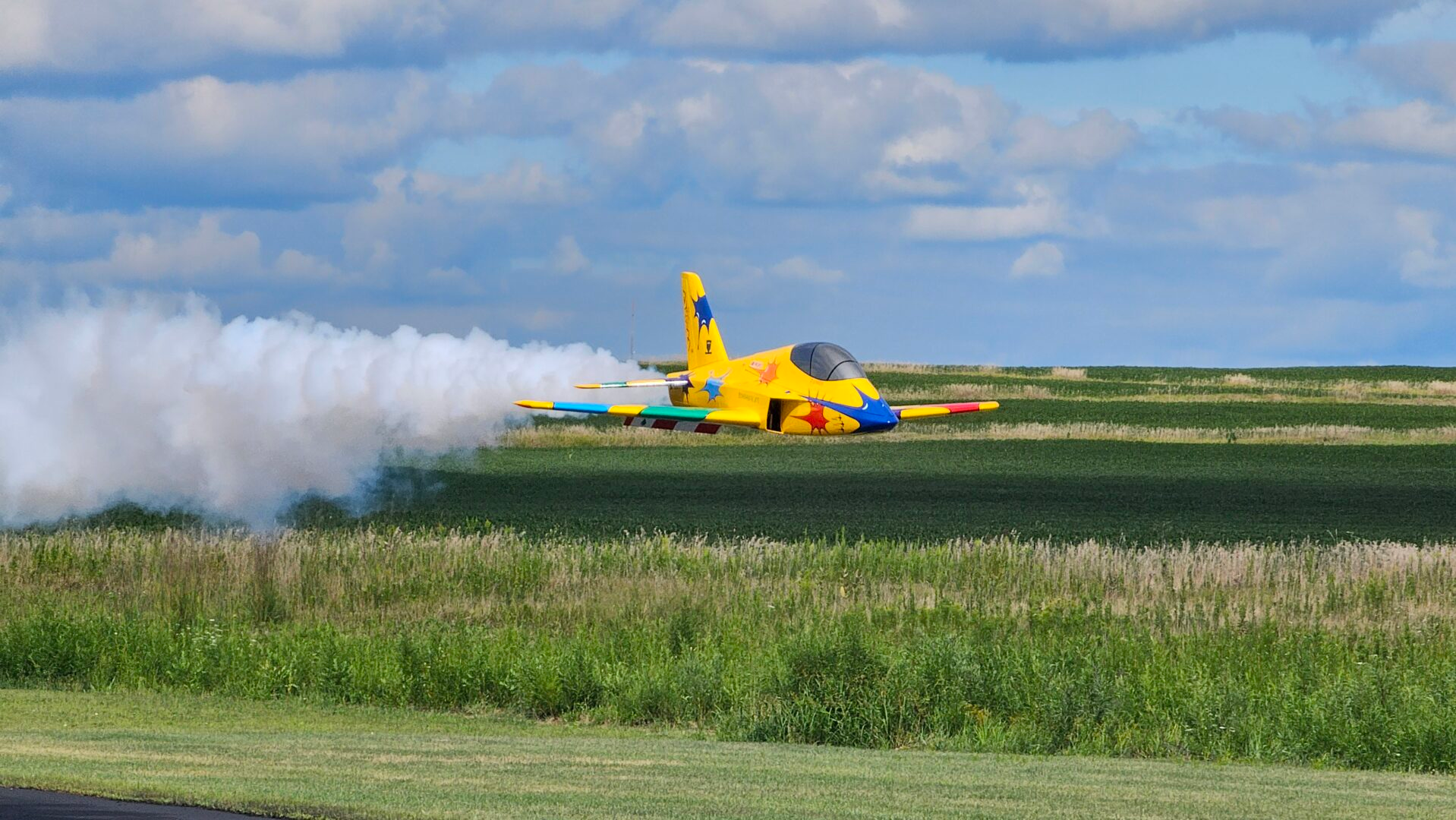
A smoke system can make a turbine jet look even more impressive in the air, as the photo at the top of this page shows. The white trail does not come from the turbine fuel. A typical setup carries purpose-made smoke oil in a separate tank and uses an electric pump to send that oil to an injection fitting in the hot exhaust stream. The heat turns the oil into the dense white smoke you see behind the airplane.
The basic pieces are straightforward:
- Smoke-oil tank: A separate, securely mounted tank sized for the airplane and the amount of smoke time you want.
- Smoke pump: An electric pump that moves the oil at a controlled rate.
- Heat-resistant plumbing: Tubing and fittings suitable for the installation, routed away from anything that could kink, rub, or overheat.
- Injection point: A fitting or nozzle placed in the exhaust system according to the airframe, turbine, thrust-tube, and smoke-system manufacturers’ instructions.
- Radio control: The pump is normally assigned to a switch or proportional channel so the pilot can turn the smoke on and off in flight.
The important part is planning the smoke installation as part of the whole airplane. The extra tank and oil add weight and can change the center of gravity as the oil is used. The system also needs to be protected from heat, secured against leaks, and positioned so it does not interfere with the turbine installation or radio equipment.
Smoke usually works best when there is enough exhaust heat to vaporize the oil cleanly. Running too much oil or using smoke at unsuitable power settings can leave residue and may allow oil to collect in the airplane or exhaust system. Use only smoke fluid and equipment approved for your setup, follow every manufacturer’s limit, and have an experienced turbine modeler inspect the installation before operating it.
Safety and Training Come First
A turbine moves a lot of air, creates very hot exhaust, and carries a meaningful amount of fuel. Keep people and loose objects away from the intake and exhaust areas, secure the airplane during ground operation, have the appropriate fire extinguisher ready, and use only the procedures and limits published for your engine.
Do not try to learn turbine operation alone from an article or video. Work with an experienced turbine pilot and follow the requirements at your flying site.
Getting a Turbine Waiver in the United States
If you plan to fly a turbine model solo under the AMA program, you need the appropriate AMA turbine waiver. In broad terms, the process starts with experience on high-performance models—the AMA says applicants should have at least 50 flights on an appropriate high-performance airplane—followed by turbine training on a buddy box with an experienced turbine pilot.
When you are ready, you complete a qualification flight and demonstrate safe ground operation, fire preparedness, failsafe setup, turbine-lag management, takeoff, flying, and landing. Two experienced turbine pilots must supervise the qualification, and one must be an AMA Contest Director. After they sign the application, you submit it to the AMA with the current processing fee. Your first five solo turbine flights must then be supervised by an experienced turbine pilot and follow the AMA’s additional limits.
That is only a quick overview, so read the current AMA Fixed-Wing Turbine Waiver Qualification Guide and application along with the AMA Gas Turbine Program rules before beginning. Requirements can change, and the current AMA documents are the final authority.
A Sensible First-Turbine Path
- Spend time with turbine pilots at your club or a jet event.
- Read the airplane and engine manuals before buying supporting equipment.
- Choose a proven airframe and power combination with good manufacturer and community support.
- Have an experienced turbine modeler inspect the installation and help with ground runs.
- Use an experienced turbine pilot for the maiden and initial setup flights when possible.
That last step mattered to me. After the MB-339 was assembled and set up, I took it to Eli Field and had Ali Machinchy handle the maiden and Synapse setup flights. Having the airplane’s designer perform those first flights gave me a much better starting point for my first jet.
Continue with the Practical Turbine Guides
Follow the MB-339 Build
If you want to see the actual airplane that helped me understand all of this, visit Ron’s Hangar 9 Aermacchi MB-339 Build Log. It shows the assembly, the turbine-system installation, the problems we found along the way, and videos from the airplane’s first flights.