
Garry Gilbert joins Ron and Tom to share a lifetime of aviation stories, from family-built airplanes and early RC flying to full-scale aircraft, memorable crashes, foam models, and custom ARF projects.
In this episode
Garry Gilbert joins Ron and Tom to talk about his family’s aviation history, scale models, memorable trainers, and lessons learned around propellers and batteries.
Chapters
00:05 — Garry's family history in aviation
10:18 — Scale models, wing attachment, and design changes
20:01 — Trading stories without trying to outdo Reggie
30:24 — Propeller safety and frightening aviation moments
40:09 — The Miss 2 and memorable trainer airplanes
50:05 — Battery mistakes and lessons caught on video
Episode Topics
- A multigenerational aviation family
- Learning RC with a Great Planes Big Stik
- Preflight checks and hard-earned lessons
- Full-scale and model-airplane stories
- Foam, ARFs, scale projects, and custom building
Key Takeaways
- A consistent control and preflight check prevents avoidable accidents.
- Crashes become useful lessons when the pilot identifies the cause and changes the routine.
- Garry's stories show how model and full-scale aviation can remain connected throughout a lifetime.
Join the Custom Foam & ARF RC Airplanes Facebook group.
Episode Gallery




Episode 105 Transcript
This transcript has been lightly edited for readability. Timestamps are retained.
Read the full transcript
[00:00:05] Hello everyone. Welcome to the RC Plane Lab podcast. I’m Ron and I’m Tom. Today we’re sitting down and talking with gary price gilbert. Gary comes to us out of georgia. Gary, welcome to the show. Why?
[00:00:20] Don’t you tell us a little bit about yourself? Well, my name is gary gilbert. I live in hiram, georgia. I am the vice president of douglas county air models in douglasville, georgia. I’ve been in and out of rc since 1990s. My family has been in aviation since I was born and, excuse me, my family’s been in aviation for a long time. My grandfather back in the 70s had a hobby shop in
[00:00:53] Spotswood, new jersey, where my father learned and built model airplanes. He was my father was one of the first people to bring quarter scale aircraft to rhinebeck aerodrome for their annual model meet. Later on in life my father started building a home-built airplane- a peat and pole air camper, where I started getting involved in building and stuff like that and when I was about 11 or 12 we had got a great plains big stick and that started my love into the rc hobby. So I’m currently now I
[00:01:31] Work for lockheed martin and I build airplanes C-130J’s for a living, so my whole day is building model airplanes or building real airplanes. That’s awesome. That is awesome. I wish, I wish you.
[00:01:44] Could see Tom’s face right now it is just lit up with his big smile about the stick and all.
[00:01:49] That kind of stuff. That’s right up his alley. Oh yeah, for sure, I obviously. I love big sticks, and the fact that you started out with a big stick 40, I think, is fantastic. It’s what a great flying.
[00:01:59] Airplane. What? What happened to that airplane? Well, so when I finally got around to- I guess you could say, soloing and flying on my own, I was probably like 13 years old. I think it was my third season flying rc. I had gone with a buddy of mine to an rc meet and it was the first meeting of the year, so I’d gone the whole way. This is. I lived up in new hampshire at the time so we had the winners you didn’t fly, so it had been a while. I got back it’s like: okay, where it’s nice spring day.
[00:02:35] Where you go out and fly. My dad was like, make sure you check everything out on the airplane before you fly it. And I was: yeah, yeah, yeah, I know. Well, I started it up and went to take off and I don’t know- I’m not 100 sure even to this day- what happens, but I would assume that I’d messed with the radio on another airplane. This was the time where you’d have to. You bought the same crystal or you got the same receiver and I had set it up for another airplane, a pt-60 trainer and I think the
[00:03:08] Ailerons were reversed from the oops, the switches in the back and as I climbed out and I went to roll, it rolled the wrong way and of course it spun into the ground and I pretty much completely destroyed the wings and the front of the fuselage. So it was just a usable tail at that point and I had to do that walk of shame out there to go get the airplane and come back and when I brought it home I brought it downstairs all busted up. My dad immediately knew exactly what I did. He’s just
[00:03:39] Like he didn’t do a pre-flight check and I was like no I did I did I’m pretty sure I didn’t yeah.
[00:03:45] Yeah so been there done that yeah we all have and you learn so right I mean hopefully that’s a lesson.
[00:03:53] That you had only take five or six of those lessons for me to learn that so yeah you’ve got to.
[00:03:59] Start somewhere. Well, it really did kind of put in because anytime it doesn’t matter if I’ve flown that airplane five times that day. Every time I go up I do my flight controls, check up down, left, right, all this and then thrust and then check my throttle cuts and all that. I do it every single time. And I think between that and when I was got out of the hobby back in 93, 94 ish, I was going to get my private pilot’s license and that was beat into me by my instructors. It was every time.
[00:04:33] You do your chat, your flight controls, checks, controls, instruments, gas, attitude, run up, safety and you’re off every single time. Right, and it’s kind of stuck with me and I haven’t put one in due to not doing a checklist sense. So that’s awesome, that’s a pretty good run. I put them in for.
[00:04:51] Other reasons though well yeah we’ve all done that it’s yeah we don’t want to dwell on.
[00:04:58] Our mistakes, but as long as you learn from them. Yeah, that’s part of the hobby. It happens occasionally. You can’t fly for more than 20 years without crashing at least one, whether it’s your fault or not, right?
[00:05:09] So right see, Tom, Tom doesn’t crash his own airplanes, he does, no, I just crash Ron’s anyway. So you, okay, you’re around airplanes all day. When it comes time to enjoy the rc side of things, are you foam, are you balsa, are you ARF, are you a kit? I mean what? What do we do? So when I got back into
[00:05:34] The hobby this two years ago. I started out with just getting ready to fly airplanes and it mostly the umx line from horizon and that was just to get me in and flying stuff. And then I moved into the larger foam airplanes to where I believe I started building like that or buying like the flight line series, free wing series from motion rc- and just putting in my own receivers, plug and play.
[00:06:04] Stuff. Once I got a couple of those and we’re flying different types. I’ve started moving. I’m moving now currently into building again. So no, I, so I last year I’ve started building a, or I built a dancing wing, hobby’s fiesler storch. It was a really cool build. It’s kind of built like a jigsaw puzzle. You don’t have to build on the plans, everything’s kind of slotted and glued there’s.
[00:06:36] A lot of shaping of balsa blocks for, like, leading edges and detail parts and stuff like that. There was a lot in terms of making the. I used oratex fabric because I wanted that fabric. Look to the airplane and that stuff’s expensive but it is when it’s done. Yeah, it is. Ron knows how.
[00:07:00] Expensive it is I haven’t used it yet yeah but you have some I have one rule do you yeah I’ll.
[00:07:06] Give you a little bit of a pointer on what I think needs to be done with that, because it doesn’t stick down like monoco does. So it’s- it’s not as tacky, but anyway. So I built that storage, I did a custom paint job on it and flew it, and it flies like a brick. It’s probably the worst flying model I have and I’ve flown it three times and it’s just been. Each time I have to go in and do something major to the design and try to lighten the airplane up and try to get more power, and that’s unfortunate.
[00:07:44] At: yeah it, but it looks great. It’s a beautiful model. I love the way it looks. It hangs up in my shop but all it’s doing is driving me to do another storage in another kit. Okay, because I think the way that kit was put together it’s one of those airplanes: as you’re putting it together, you start looking at it. You’re like I wouldn’t have done that this way, I would have done it this way. But you continue building it to the plans and then, when you’re done, you’re like I should have just done it the way I thought it. The wing attachment points aren’t the best, in my opinion.
[00:08:16] I know a lot of guys have built it and flown it and enjoy it, but I must have skewed somewhere because it, like I said, it flies like a brick. It’s it’s, but like it looks good, so I’m happy with that.
[00:08:29] Well, I doubt that it’s anything that you did to it like if you built it according to the plans, and that the kit- I’m familiar with the type of kit you’re talking about being in like a jigsaw puzzle, like the fuselage sides aren’t like one piece. They’re pieces that have, like the, the notches or whatever, like the laser cut. So there’s really nowhere for you to go wrong. I mean, if you build it according to plan, then that’s poor planning. I would think so, yeah, so.
[00:08:51] Yeah I wonder I wonder if the weight of the covering would have had something to do with it too or maybe.
[00:08:55] Whatever paints you used, maybe so well, yeah, and that’s what a lot of, and that’s a lot of guys ask me about that, because I actually use house paint, but I thin it down 50 with windex and then I spray.
[00:09:08] It yeah that’s what dave that’s what our friend dave does as well and he has fantastic results with.
[00:09:13] That and I have- I’ve had awesome results with it on other aircraft that I’ve done that before, I think with this one. With it, the storch tail is a very, very long tail and it’s got a decent size nose on it so it’s not really short coupled, but that tail’s really long. Yeah, the way it’s built, it almost gets. There’s a lot of material in that and towards the back of the tail, so the airplane ended up very tail heavy at first and I had to add a lot of weight to the nose.
[00:09:44] Oh. So as I think I added like one and a half pounds of lead to the nose here, the cgn holy. Yeah, it’s ridiculous. Well, that’s why it’s a brick, that is a lot. I have since pulled all the lead out and moved the battery into the like, into the cowling of the airplane. Yeah, to get it as far forward as possible. Sure, if you get it to get as much weight as possible. Yeah, to get it as far forward as possible. And I have the CG in there, in where it needs to be, but I haven’t flown it since. I’ve taken a lot.
[00:10:18] Of the weight out. The other thing is the way the wings attach. There’s only one bolt in the back and it allows the tips to move back and forth. So I need to figure out a way to get that rigid. Plus, I need to add a little dihedral to it. Doesn’t seem like a great design. Yeah, no, no, no. I found a, and the thing about it is it’s an. It’s an odd scale and I’m very scale oriented, like I like to have. So a friend of mine. He had a p-47, the fms one with the 1400 millimeter wingspan.
[00:10:50] And when I was buying a counterpart to his p-47, I started out with: what scale is that and what airplanes are in that scale? So when we’re flying together, that’s the way it would have looked in.
[00:11:02] Real in combat yeah that’s I love that so what’s the what’s the wingspan on.
[00:11:09] That one, the store 1600 millimeters. Oh boy, I gotta do the math, so we’ve done this before. That ends up being what about 50-ish inches? I think it’s a little bit bigger than that. I was thinking like 56 inches. I.
[00:11:25] Think something like that. Anyway, yeah, it’s a decent. It’s not a smaller plane, but for a pound and a half of weight for a pound. Yeah, that’s wait. I mean he was able to take most of that out. It sounds like so.
[00:11:35] Yeah, flaps. Yes, it has flaps, and I programmed the ailerons to droop with the flaps, like the real one, so as the flaps go to their first position, the ailerons match it and then the flaps go the rest of.
[00:11:50] The way cool. Correct me if I’m wrong, but I believe that is what draco is modeled off of right, I believe so I’m. I believe so. Or storage, it does look like that. Yeah, yeah, I think it is, but anyway, a highly modified one, of course. But, yeah, yeah, it’s a nice looking airplane, by the way, just expensive for foam, I think. Yeah, and that’s what Ron and I go back and forth on. I mean, foam looks like foam.
[00:12:16] It really does and I probably like most of my collection you could look is mostly foam and, like I said, I’m gonna, I’m okay, I’m trying to get out of it right now I’m like, I’m like I don’t want another foam model, I want to build. So I bought, I have the one six scale, one six scale SIG j3 cub and the clip wing cub. Oh great, flying airplane, I think that’s what. 80 Inch wingspan. If
[00:12:47] I remember right well I don’t think the six scale is quite that big is it this the it’s 71.
[00:12:54] Inches. Yeah, well then I’m not sure what one I ended up with. So the first kit I ever bought was a cub and I thought maybe I’m wrong on the scale. It was an 80 inch wingspan, but that was the one. I never finished, so it’s probably the one-fifth scale one. Yeah, that’s what I’m. Oh, maybe that’s okay. Yeah, because that was made quite a few different ones. Yeah, that was one. I bought a, bought off of them because I wanted to kind of see how a kit went together and stuff, and so I was building and I got the wing fairly through the building process on the wing and then I actually
[00:13:26] Bought a completed ARF that was ready to fly and I was like, well, I don’t need two of them, so I use the rest of the wood for other projects. Yeah, oh no, you can’t have too many cubs. Well, what that was when I first started and I’m, I’m, on board with you now. Yeah, yeah, back then that, like I said, that was the first kit I built. I had never actually flown a balsa airplane. At that point in time, I had no clue where that was going to take me to today. Right, well, yeah, had I known, then I would have, would have finished. Yeah, but no, gary’s absolutely right you.
[00:13:57] Can’t have too many cubs, and right now I have zero. Well, you can’t have too many airplanes period. Right, that’s something you gotta fix. Well, I’ve got, I’ve got. I have a goldberg cub kit that is waiting to be built and I will eventually build it. But yeah, I, I need to get a cub in the
[00:14:13] Collection because, yeah, they fly great, they do. I mean, they’re just a cub- is like the quintessential RC airplane that I think everybody has had, yeah, or has. Yeah, my first, my first one. I was gonna say my first airplane was a cub, it was a foamy, but still it was a great little airplane to learn on. So, speaking,
[00:14:32] Of cubs gary yes you and your family you are currently constructing a cub we’ve built a full.
[00:14:40] Scale aircraft before pete and pole air camper, a 85 scale foker dr1. That was never completed. We kind of did that through a museum and the eaa. And then so this l4, what we’re building a j3 cub, but it’s an l4, which is the military version, so that’s the one. Its actual designation is a l4 h. Okay, so this would be a l4 that was used in 43 pre invasion, so it started out with:
[00:15:18] Purchasing plans from wag arrow who does kit built cubs. But their spin on it, and being that my father and I and all that are very we want it done, if we’re going to do it, we’re going to do it like it was originally done. So my father, through a lot of talking and going to, actually going to where the old piper factory was in pennsylvania, writing pennsylvania and talking with people that
[00:15:50] Built them, acquired a full set of l4 drawings from piper and we started building it from scratch. That’s awesome, that is cool. Now we did do some. We took some liberties in terms of building materials, like we didn’t. We didn’t do the aluminum ribs, we built wood ribs. So the airplane, exterior, exterior, wise, looks exactly as it should be. Interior wise, there were a couple things that were changed for safety and to my father, my, my family is all engineers. I’m the mechanic in the family, so
[00:16:29] We went through the. The real j3 club has an issue with the tail twisting over time and we re-engineered a brace to go back there to hopefully stop that from happening. Nice, but right now the airplane is sitting up in northwood, new hampshire it is. We are waiting for a hangar to assemble this airplane and start flying it this year, but right now there is a shortage. Because of the whole covid, there’s a shortage of airplane hangars. Oh really, nobody has one. We’ve been on a waiting list for four.
[00:17:02] Years still haven’t gotten the hangar. Wow, that’s a long time. It’s a long time. The fuselage, is it chromoly tubing and all that kind of thing? Yes, it’s all chromoly tubing, modern tubing, the- now, I believe I, I don’t remember off the top of my head, but the stabilizer and elevator are original l4 parts. The wheels and brakes are original l4 parts. So there are some original l4 pieces on the airplane. Yeah, very, very cool, that’s really cool. Yeah, and the next project is we are designing
[00:17:40] Off of a set of plans. We got from new zealand, I believe, a storage one, fi 156 storage. But we are going to scale it down because a lot of people don’t realize that storage was a giant airplane: 47 foot wingspan. It was 10 and a half feet tall. It had a giant 200 horsepower argus motor in it. That was air cooled inverted v8. So we’re going to try to scale that down to 80 percent scale I think we. At the time I sent you the email it said 75 but I started looking at the scale of it and I was like
[00:18:15] We need to go up a little bit, because the airplane will actually end up being smaller than the l4 and it should be bigger than the l4, so we scaled it up a little bit. So, but we’re working. That’s the design. We’re in the design process of that now and I’m hoping by the end of this year I will be building the ribs for it and start building the wings down here in georgia. My father is going to be moving to georgia in the next year or two, so we’ll be getting together and building that cool pictures, or it.
[00:18:46] Didn’t happen that’s right oh yeah that’s I’m I’m horrible about that saying you guys still need.
[00:18:53] Pictures of me. So yeah, just ask, Ron, I’m terrible at it too. I get, I get down on my firm, I get down on my workshop and I get busy, and then the last thing I’m that’s on my mind this is: oh, I gotta stop.
[00:19:04] And take a picture of this. So I’ll be honest, I do the same thing, though. So it’s once you get in the zone, like you don’t think about anything else. You’re just working on your project, enjoying your time and making progress. The thought of stopping to snap a picture never, even never really hits me, so all.
[00:19:20] Right. So that’s very cool. You’re building some: a full sky, a full scale l4 and an 80 storage, which that’s awesome, but we’re here to talk about rc airplanes. Well, hold on, I’m sorry, hold on, I do have.
[00:19:33] To go back and one of the emails that went back and forth between us, you said that you’ve crashed many rc airplanes, but you have also crashed a real airplane. Oh yes, that conversation let’s, let’s. Let’s talk about that really quick because I’m gonna be honest with this story. You are one-upping Reggie. Well, he’s never crashed a real airplane before. So, yeah, so I know he hasn’t told me. Well,
[00:20:01] Hold on listen I just got to tell everybody the object of the show is not to one-up Reggie we don’t.
[00:20:05] Know that’s true yeah that’s that’s that’s very true that’s a that’s a high bar that nobody.
[00:20:11] Wants to know. No, no, all right. So tell us about this. Yeah, I want to know, okay, so, like I told you before, my father, when I was around eight years old, he started building a pete and pole air camper and by the time I was 16, it was completed and this is an all wood airplane, open cock, that high wing parasol. Parasol, yeah, that’s powered by a model, a ford engine. That’s kind of so. Yeah, yeah, it’s it. We. We did some modifications in terms of redesigning some stuff on the engine to get more.
[00:20:42] Than the 39 horsepower. We were getting a whopping 55 horsepower out of it. Yeah, that’s like we were swinging. We were swinging an 80 inch propeller at about 1700 rpms and it looked cool. That airplane was beautiful. I’ll send you pictures of that airplane so you can post it to the website and a picture of me. And it crashed anyway. So I got my pilot’s license at 16, at being 16, 17 years old.
[00:21:13] I was like a kid in a regular car, like you get out there, you drive fast and you do things. So I was very, yeah, I like how you put this drive fast and I do things. Yes, well, you take chances because, yeah, I know exactly what you’re talking about, exactly, yeah. So, anyway, I think at this time I was- I believe I was 17 or 18 years old- we had brought the airplane out for our local air show that we had
[00:21:45] At our airport and everyone wanted to see it fly. It was a little windy and my dad being a little bit more concerned, I was like I’ll fly it. I don’t, I’m good with it. I can fly in this little bit of wind. And I took off, I got out there, started it up, taxied it out. Now this airplane does not have brakes. It has a tail skid, not a tail wheel. So and it’s it’s a lot like flying a world war one airplane. It’s very bouncy on the ground. It’s hard to control. Anyway, that all being said,
[00:22:19] I took off at, and I mean the runway was had people lining it. I took off and my idea was to come around and do a low pass at a whopping 55 miles an hour, but it’s still cool. Yeah, and at the time the model a ford’s oil cap is not screwed on, it’s just compression fit on and we have had some issues where you added oil to it and it would over pressurize the oil system. The cap would blow off. Well, that’s what happened. The cap blew off and I saw the white smoke kind of puffing out of the engine.
[00:22:50] And I was like crap, I need to land and we need to put a new cap on. When I came in, this was a grass strip runway. I had touched down a little on the hard side, but not too hard, and I was rolling out and the airplane started settling to the left really hard and I thought I was going into a ground loop with it. And so I’m correcting for the ground loop and the airplane just keeps settling, settling over, and I’m holding the stick and I get the stick jammed all the way over to the right or to the
[00:23:22] Right, trying to keep that wing up and I don’t know what’s going on. And next thing I know I heard crunching of dirt. I’m looking straight at the ground and then I’m upside down. Oh dear, oh yes. So during that my face made contact with the cockpit combing breaking my jaw right below my nose. My skull right below fractured that. I sprained every joint in my body with the exception of my left arm, lucky to be alive.
[00:23:56] Yeah no it really wasn’t that bad of an accident one of the sounds awful.
[00:24:05] It really. Yeah, I still have. Like I, my septum is completely pushed over to one side from the accident on my nose. But yeah, it was, it was. It was surreal, and I just remember sitting there thinking about how pissed my dad would be that I just crashed his airplane. Yeah, that would have been my first thought too. Yeah, and I’m thinking about that big stick, believe it or not, and I’m just like: not again, not this. That’s what I kept running through my head, oh great.
[00:24:35] I’m gonna have to hear about this for the next 40 years. Yeah, yeah, so there was a photographer taking pictures of this airplane and he actually has a picture of me hanging upside down right after the crash, still hanging upside down from the cockpit. Wow, yeah, and my father and my best friend, david at the time, had run over there before everything else. Now, mind you, the fuel tank is in the center of the wing and it had 10 gallons of fresh av gas in it and it’s dumping out everywhere. There is this.
[00:25:06] Model, a ford engine that is dumping water and heat, and all that right above this puddle of fuel. Yeah, and I just remember hands pushing me in and pulling me out of the cockpit, and then I had to call my mom, so and explain to her what just happened. And I think I started that conversation out with I’m okay, dad’s okay, dave’s okay, but the peat and pole was crashed. So what happened? Oh so, the landing gear.
[00:25:36] It’s held on by bungee cord. The wheels were these 29 inch kind of spoked wheels covered with fabric, like the old world war one airplanes. There was nothing holding the length of axle to the landing gear, besides for the bungee cords. One of the bungee cords had dry, rotted inside and snapped. Now there’s a safety cable that holds that landing gear just in case that bungee cord snaps. And that failed.
[00:26:07] As well. That big wheel went back into the strut, lock that wheel down as a brake and cause the airplane to flip over on its back. Ouch man, wow, yeah, so not your fault, at least, though I mean no, no, and I, I remember like I, I always listen to- anytime I can listen to- an old pilot talk about their experience and stuff like that. I try to take note of it, and the one thing I learned- and it was, I believe it was said- I gotta try to remember the guy’s name now, bob hoover. Who’s that famous stump pilot that flew the?
[00:26:43] The twin. Yeah, he said, fly the airplane through the crash and you’ll survive. And that’s always resonated with me and even with rc: fly the airplane to the crash, do whatever you can, keep that airplane flying and you, the airplane, will end up better. So of course, that doesn’t work in rc. Sometimes, when it disappears behind the trees, we’re in the corn or behind the corn. Yeah, yeah, yeah, so yeah, but that’s my airplane crash story. I was, I had that and I also had a hard landing in iraq and a black hawk. So
[00:27:18] But that was. I’m just sitting in the back and I got slammed into the pilot seat- pretty bad- and we busted a tail strut. Oh yeah, that was. That wasn’t fun. So I’ve been through two incidents in aircraft.
[00:27:32] Well definitely two more than anyone else I know yeah so you win too many I would agree with that.
[00:27:39] Yeah, nobody wants to have to deal with that stuff. So, yeah, at least you’re okay. Yeah, that’s the important part and you, you did get a story to tell out of it and I mean like, compare then full scale to rc. Obviously rc is less dangerous. So does that become like more fun or just less stressful? So I, with rc, I
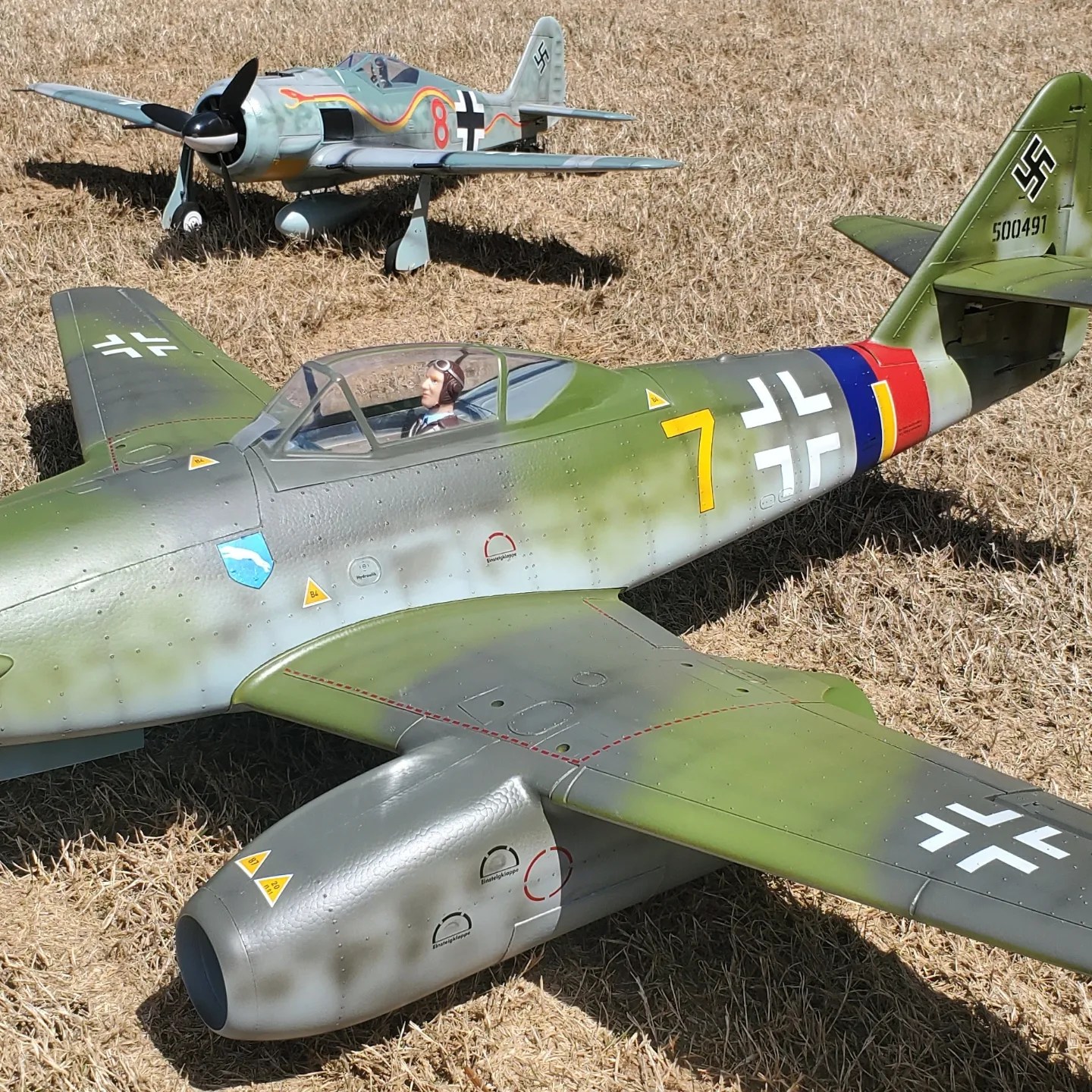
[00:28:01] Find it more, it’s more fun. The biggest thing is I my dream would be to have fly every world war ii airplane, every korean war jet fighter, world war one airplane. I’d love to do it but let’s face it, nobody really has the money to do that, so that’s how it’s what rc does for me. Although I enjoy going up and flying 172s, cubs and stuff like that, I get to fly an me 262 from time to time, or a
[00:28:31] Fox wolf or a p51 or corsair, and it’s just something you can’t do in your normal life and I, I just absolutely love that. Not only that, I use my models to try to teach people about it, about not just rc, but history. I mean, that’s one of the coolest things that this is a multi-leveled hobby, and I never like when I build, like my me 109 that I have- it’s in finnish paint schemes, so
[00:29:02] It has the finished hook, blue hooked crosses. They look like swastikas, actually look exactly like a hot swastika, but and they’re blue. I have that on there and everyone looks at it and they’re like, oh, that’s a nazi airplane. I’m like no, it’s not, it’s a finnish airplane. And then there’s a whole history of why finland was flying american and british aircraft at the beginning of the war and then ended up flying with germany towards the end of the war and it I help. I like to use that as a way to teach people about aviation history, world history and stuff about the hobby. So I
[00:29:38] Really enjoy that aspect of it, so and that I really it. It helps relax me, it helps bring a level of enjoyment that allows me to interact with people, so I do enjoy that awesome. Yeah, I can.
[00:29:55] I can see where rc is. It’s a. It’s a very low bar to get into compared to full scale. For anybody that just has a, a hankering to go fly or to be around airplanes or something like that, because yeah, I can’t afford to go out and buy a real airplane right now and fly it around. So yeah, rc kind of fills that need and obviously it’s a little bit safer. It is well. I’ve got a couple scars on.
[00:30:24] My hands from propellers biting me and stuff like that yeah I’ve only been scared for my life a couple.
[00:30:29] Of times in the pits when someone else was flying so I mean yeah relative is the term to use.
[00:30:35] Yeah, but at least with that you can go hide behind the someone else. Well, I was gonna say something else, I was gonna say the tables, but yeah, I guess someone else too, depending on who it is. Yeah, so that’s that. That’s amazing. Yeah, full-scale stuff crashes and all that are kind of
[00:30:55] Scary, that’s the word I’m gonna use actually. So you took the words right out of my mouth. I’m sorry again. That’s okay, all right. So rc planes- let’s talk about rc planes. I’m gary, I’m I’m kind of running through the, the list you sent us, and doing some quick math in my head and your overall number, if we can talk about it. Yeah, absolutely, because he does have a, a note in here that something about the wife not knowing about. I think we all have a note like that on our
[00:31:22] List yeah a lot of a lot of the airplanes here are tommy’s and a lot of the airplanes at tommy’s house.
[00:31:27] Are mine so yeah it’s something like that yeah those aren’t mine those are those are wrongs yeah.
[00:31:32] I’m just holding them for somebody yeah exactly all right so a little bit of quick math here I.
[00:31:38] Come up with about 37. It’s a very good. I think it’s right about right. Yeah, so quickly, if, if you don’t mind, I’ll run down the list because I like to. I like to see what kind of airplanes people hang on to them, yeah, what they don’t. So I like how you have everything organized here, nice and neat. So I’ll just get right to it. Here, from the umx line, you have the champ, the radian, the pt17, the pits- one of my favorite- the, the waco, a piper cub, the timber, the t28 and se5a, which is a another.
[00:32:11] Favorite of mine- and then the foker d7- excuse me, d8. So yeah, that’s actually a pretty, pretty nice umx collection just by itself. But then foam board, which are kind of a kind of like a sandpiper type arrangement. Just foam board and stick them together and you’ve got a looks like a ft’s flight test, correct? Yes, so we got the mighty mini p51, the mini f4u, the mini f22 and you have a.
[00:32:42] Flight test stick and then you have a depron foker e3 eindecker that sounds like a cool airplane.
[00:32:48] Actually yeah that’s scratch built I scratch built that one but I didn’t have a category.
[00:32:54] I figured it falls in the foam board category. Now, Ron and I- well, mostly me- we kind of like, not that we frown upon, but we’re not huge fans of the foam airplanes. However, the ones you scratch, build yourself, like. Ron designed the sandpiper and it actually flies pretty good. Those are actually a lot.
[00:33:14] Of fun. Those are fun for the, for the cheapness that you’re, that you’re dealing with. You don’t have to worry about an actual long build. If you crash it, you crash it exactly. I don’t care. However, I will say- and, like the foam airplanes, I might, I might be coming around to them just a little.
[00:33:31] Bit yeah I mean they are they do look good they look good from 20 feet away right exactly if you’re not.
[00:33:37] Close enough, and I think that’s my thing is, you see them up close and you see all the little beads of foam and that’s kind of what I don’t like, but I think I’m I’m starting to come around.
[00:33:47] Because what an airplane is an airplane it’s still an airplane right yes I still prefer.
[00:33:52] Balsa I prefer balsa but I’m I’m not going to poo-poo on the foam as much as I used to poo-poo.
[00:33:58] Yeah, I said poo-poo. Okay, all right. So moving on, 60, 64 millimeter edf’s electric ducted fans- these are all scale birds: an f9 panther, f86 saber and f8 crusader. Where’d you find a crusader?
[00:34:11] In 64 millimeter. That’s the motion rc one. It’s available now. I may have, I’m having I. I just flew it for the first time the other day actually. Yeah, fly good. There’s some tweaking that needs to be done. Okay, but it’s in one piece. It’s still in one piece, right, the elevators are no longer attached. They just need to get glued back on. Oh okay. Oh so I landed in some bushes. Okay, all right.
[00:34:39] So that was my fault. Yeah, well, it happens. Yeah. And then so, 70 millimeter edf, you got an me 262, which is a really awesome twin engine. German warbird, yes, and then you have moving on to warbird, so you have a soft with triplane music to my ears. Those are awesome. A 190 d9, a 190 a8- which a8 do you?
[00:35:01] Have is that’s the flight line free wing one okay yeah that’s a good looking airplane.
[00:35:07] F4 corsair the bf 109 g6 I’m not sure what that means is that oh that’s just the g6 is the.
[00:35:14] Model number okay rounded nose all that’s a dynam model okay cool and then a pt-17 a mig-29 and.
[00:35:23] Then the fiesler 156 storage in balsa. He’s got that in parentheses there, thank you. And then sport planes. You got a timber, the one and a half meter and 855 millimeter pits, the do 27, which is the fiberglass one. Yeah, cool, balsa super cop. And then a great plane’s pt-60. And then- note, you have on this one on display in an airport restaurant in new hampshire. I gotta guess about that. Okay, so there’s a restaurant in new hampshire that has your. Is this your original great plains pt-60? Yes, from the.
[00:35:58] 1990S. That’s awesome. That is awesome. That is awesome. I’ll give it’s actually in and there it’s. I got the magazine but it’s in model airplane news. There’s a picture of it really hanging up in that mute in that awesome restaurant. So, like I said, I lived up in new hampshire as a kid and when I moved away I still had this airplane. I still had it and it’s a pt-60. It has an
[00:36:28] Enya 40 on it, so interesting it’s okay. It seems like it would be very underpowered but it’s not. It flies really great. It flies very scale or sure it flies very well. So yeah, but my father painted it. It was all yellow with red bands on the wing and tail and it’s got american star and bar navy on it. So if you picture like kind of a stearman or a at6 texan paint job on it and it’s all airbrushed and
[00:37:01] Weathered with the shark’s mouth on front, on the front of it, everything really. And it has a set of old dubro wheels from my dad’s and my grandfather’s hobby shop on it, and I don’t know why, but that makes me smile. That it has a part from their old hobby shop on it absolutely makes me smile. It’s not even my, my story. Yeah, so that it. When we first built it we took it to an rc model competition with that. Our club at the- I think we were called the rc aces at the time. They had a show that.
[00:37:34] They put together with all the other clubs and it won first place in the trainers because of how good it looked and when I moved to illinois I had to do something with it. So we, I went to the airport that I learned to fly out. There was a restaurant there and I said: do you guys want to hang it up for a display? Because they had a bunch of models hanging up there and they’re like: yeah, sure, and that’s where it’s been since 98, 99 and it. They have a little motion track so it goes around the
[00:38:06] The, the, the restaurant, like it’s flying around. It’s kind of cool really. That is so, yeah. But I was going through model aviation magazine one day and I looked down and there is a little corner picture of it. I’m like holy crap, that’s my airplane. Yeah, that’s awesome. Yeah, and it’s still in perfectly good flying condition. They’ve taken very good care of it. But at this point it’s been there 25 years. Around 25 years. It’s kind of become a staple to that. So I’m just like you guys, keep it.
[00:38:38] And I’ll build a new one if I ever want to build one again so yeah and good thing the pt60.
[00:38:45] Is a fairly simple airframe if you wanted to build one from plans it wouldn’t be hard yeah it’s.
[00:38:50] I think like the tail was all just slab quarter inch balsa and the fuselage was the same way. The wings were the only thing that really took any effort to build right. Yeah, and that was just standard d-tube.
[00:39:02] Construction, I remember, because I built a pt-40 way back in the day. So, yeah, and good, good, flying trainers, oh yeah, awesome, mine’s not hanging up in an airport though, okay. So moving on, we got kits that you’re waiting to build. You got the SIG clipped wing cub that you mentioned, a foam f18, foam board f18, and then you have a dh82 tiger moth, which that’s to have one right, yes, yeah.
[00:39:29] Which kit is that? That’s the dancing wing hobbies as well. It’s the same people that build the storage. So I’ve been hesitant. I’ve had that kit for about two years. Well, I bought it right after I got the storage, yeah, and I’ve been hesitant to build it because I’m like, oh, what am I going to run into with this? But right, at some point I’ll just buckle down and do it, yeah, well, don’t be afraid to re-engineer.
[00:39:51] That one as you go, because you now know you may need to. Yeah, yeah, okay, and then, and then the list that I’m very familiar with crashed, waiting for repair. You have a scorpio miss two. I don’t know what that is. I’m not sure either, like I know who scorpio is, because that’s what my fiesta 45 is. But
[00:40:09] I don’t know what a miss two is. What is that? The miss two was a polyhedral, three channel high wing parasol airplane. It was powered by a speed 400 like I think it was a groppner speed 400. Okay, very docile, great flying airplane. I mean that was my go-to trainer if I was ever showing somebody like the basic controls of the airplane. Like you could not crash, that it was almost impossible to crash.
[00:40:41] What, however, I have to interrupt? It’s on the crashed waiting for repair list. So, like I said, as you get comfortable, you get complacent and you start doing things. Yes, I am because it’s completely and like you’re, like you’re 18, all over again, yeah, yeah. So I would get out there with this three channel and show people that you can loop, roll it, you could hammerhead, turn it. It’s just all about control and watching the airplane and I was coming in, caught the wing tip, trying to do not like a
[00:41:14] Knife edge. But trying to come in kind of with no ailerons, get all elevator and rudder, kind of get the airplane in a knife exit, and I caught the wing tip and took the wing tip off. But it was the third time I had some sort of incident with it. A couple times I damaged it in my shop. For the most part, isn’t that the worst? The worst, yeah, and then it’s been recovered three times. I think so, after I broke the wing tip on it, which I could have repaired, and just started flying. I was
[00:41:50] Like it needs a new cover, job and everything. So I uncovered it. But I bought that airplane in 1995. I want to say so, it’s it. It’s the glue joints and all that. The boss is starting to get really brittle, yeah. So I’m trying to figure out. Am I going to go back and repair everything or am I going to just?
[00:42:17] Hang it up as a skeleton at this point? Yeah, like I’m not, I’m not afraid of recovering an airplane, especially if it’s an airplane that’s in still in pretty good service. But I gotta tell you, man, you talk about shop damaging them in the shop. I have a story, a recent story, about not to take the focus away from you, but no, I feel your pain about shop damage. I’m currently in the process of recovering a brand new wing that got damaged in the shop and that’s so frustrating. Yeah,
[00:42:48] Complete recover yeah that’s oh yeah that’s yeah so anyway I feel your pain and the thing about.
[00:42:54] Especially when you have something new and you do something like that, you’re like: do I don’t want to put a repair on it? Exactly, look new, thank you. So you end up peeling everything off and you sit there and you’re like, well, what can I salvage? And it turns out the best thing to do is just take everything.
[00:43:09] Off start over sand it and go back to it yep cut the ailerons off make new aileron yeah I’m that’s.
[00:43:15] Right, yeah, so brand new airplane. And every cut and peel of every covering is like taking a layer of your soul away, because you’re like: I’m not going to do it this good again. I can’t. I covered it so.
[00:43:28] Perfect this time. Well, luckily- yeah, luckily, in this case for me it was an arp, so it had been recovered or had been covered by somebody else in china- probably some little kid, probably in china, covered that originally. But yeah, no, I, I feel your pain, especially if it’s one that you had covered yourself, which I’ve done that as well. So, anyway, I feel your pain. Moving on, so that was the scorpio miss too. I may have to keep an eye out for that. I like the score. Was this an arc that the scorpio? Was it a almost ready to cover or was it a complete kit? It was a complete kit, I want.
[00:44:01] To say it was it was an ARF yeah you needed servos and stuff like that so okay but it was all yellow.
[00:44:10] With a red tail originally. Yeah, so yeah, the scorpio they were. They were pretty popular. They made what they called arc, which was an arc almost ready to cover ARF. So that’s what my fiesta 45 was, anyway. So, moving on, at 1.2 Meter clip, wing cub crashed waiting for repair. So we got to hear that.
[00:44:32] Story. Okay, so this happened about three months ago. Four months ago I was flying- painful, yeah, what’s that? Yeah, still painful and fresh. This was the first larger scale from the umx line that I got into when I got back into the hobby, so I’ve been flying. This is the airplane. I always said this is the shake the rust off the long time flying airplane because it flies so well. But it’s the it was.
[00:45:04] The Horizon Hobby, I believe- put it out, or e-flight put it out, their foam clip wing cub. So I was out flying it. I have a real- I had a really good friend that I flew with, named duane, that I did a lot of my flying with and he’s the type of guy he’s very confident on his. He was a he’s a drone pilot, so he’s very confident on the sticks. So when I had we were out flying. If it’s winds blowing six or seven miles an hour, I start getting into the I don’t want to fly phase.
[00:45:39] And he’s that guy that is like: get up there and fly, go up and fly, it’s not that windy. You got that. That model had AS3X on it. He’s like: you got AS3X, just get up there and fly. So I took it off and I’m I’m not having any trouble flying it. So he starts going me into doing different aerobatic. He’s like: do an inverted low pass. And I’m like I’m not doing an inverted low pass. He’s like: just try flying inverted, do this, that. And I’m like: so finally, I was like I did a spin. He’s like: be cooler.
[00:46:09] If you did an inverted spin. So I rolled the airplane over and I did an inverted spin. Well, I did not recover from an inverted spin, I recovered from a regular spin. Oh so the airplane, yep, just goes into a nose dive and went right into the top of the trees, to the- oh, the trees. Okay, yeah, so it’s sitting in the top of a tree and it no damage. It looked perfect. So I’m like, okay, I gotta get this thing down. So this is way out in the woods in my club, from the side of my club. So I’m out there and I’m talking. I’m like
[00:46:40] What am I going to do? How am I get this thing out? So I try climbing it, but I am not in the shape to climb a tree, so, and it’s probably a good 50 feet up in the top of this tree. Yeah, it’s up there, yeah, so I, I grabbed my, I went home. Now- this is the worst part about it, really- it’s date night for my wife and I. So I’m like, babe, I just need to run out to the rc field, cut this tree down real quick and get my airplane. And she’s like that’s fine. Now my wife is dressed to the nines and I’m running out there.
[00:47:16] In my truck, in nice clothes, with a chainsaw, to go get my model airplane. I have to cut two trees down and when the tree came down it demolished the airplane. Oh so I stripped all. I stripped all the electronics out of it and I just ordered all new foam for it and I’ll just put it back together because the airplane’s been discontinued. Otherwise I would have just bought a new model. But right now, with the supply chain issues, I’m waiting on the fuselage and the battery cover.
[00:47:46] To actually start putting it back together and I think those I ordered them back in october and they are supposed to be here in may of this year. So, yeah, I’ve been waiting patiently. But since then I bought this. Like I said, I bought the SIG balsa one, which is roughly the same size, so which you’ll yeah, that was yeah, that you’re gonna love that airplane. Yeah, they fly so well. It flies probably as good as
[00:48:12] The one you don’t have anymore oh wow rub it in yeah remember how that flew yeah this one will fly.
[00:48:20] Just like that, probably better. All right, and then so the last part of your list, which there’s not something that Ron and I haven’t done. You have it labeled as crashed and gone, like I, yes, I’ve. I don’t think I had so many that I couldn’t keep track, but you had a phoenix edge 540, an f9f panther, a 64 millimeter, which looks like you’ve replaced, yes, f, and a flight test sportster and a umx, the 50 millimeter version of the f16, yes, so crashed and gone. No, no plans except for the panther, no, no.
[00:48:56] Plans to replace any of those other three. So no, not really. Panther was my first edf. My father bought it for me for a birthday present last year or the year before and it flew. I loved it. It was one of the best flying- what I guess they call the toss and boss. It’s three channel: elevator and aileron, any, no landing gear or anything like that, and I had a great time flying it and what had happened. I actually have it posted on youtube and I’ll send you guys.
[00:49:31] The link. Okay, I did not. I’m- and this is a lesson learned that has changed my behavior- out of the rc field. I was flying a bunch of different models and I was. I set the batteries to one side and the good battery, the used batteries, go over here and the new batteries are in their in their box over here. And I had taken a new battery out and I was like, oh, I want to film this so that I can show people flying this model, stuff like that, and I set up my camera on my hat and all this other.
[00:50:05] Stuff and I went and grabbed the battery. And I had grabbed a used battery that was already down to 50 percent and I threw it out there. It flew fine for about a minute and a half and then it went into the electronic cutout on the power. Yep, and I, I- you can watch the video, it’s I. I still laugh at it. Every time I’m coming by on my field and I say, oh, expletive. I knew exactly what had happened.
[00:50:36] So I’m immediately going into try to turn the airplane back into the field, because I’m kind of over the edge of the trees and get landing right now and as I’m making the turn I’m slow. That’s a very scale built there looking airplane. Yeah, I’m turning and I lose throttle and I lose control and the airplane nose dives and crashes in the only puddle on the field. Isn’t that like our luck, though?
[00:51:06] Yeah, honestly, like a magnet. Yeah, and I knew exactly what had happened. I’d put a used battery in it, because I’m look, I looked over at the table and there’s a battery set over there. It is by the good batteries and one missing from the used. So what I do with them? And I cut the tails off and then I mount them to my wall and I try to write something underneath them like check the batteries. Oh, I don’t.
[00:51:30] Do the thing underneath but I’ve got some on my walls too I love it’s just I love the I love.
[00:51:35] The idea of posting the lesson you learned. Yeah, yes, resulted in that, and he’s being like a plaque underneath of it. Yeah, that’s a great idea, wonderful, yeah, I’m. I’m writing that down because
[00:51:45] That’s a good idea, yeah, but that’s the only one to replace, because that’s the only one that I kind of enjoyed. That phoenix edge was given to me by a friend of mine who passed away last year and he was like you’ll love it, it’s fast, it’s this, that and the other thing. And I’m like okay. So I’m taking it up for the first time myself and I’m like: man, this thing flies like it’s on rails. It’s a great flying airplane. Well, the peanut gallery. All the guys in behind me start saying like it’s aerobatic, do aerobatics. And I’m like okay, so I did a snap roll. I’m like, oh, that flies.
[00:52:21] That was great. Yeah, that was so. I’m like I did a loop, I did a regular aileron roll and I’m like I’m gonna do a dual double snap roll, because this thing is just so easy to fly. And I did a double snap roll, I got too slow and I ended up hitting the tops of the trees and that was the end of that. Those trees, man, yeah, yeah, every single time. Every time, they just jump right out of the ground and grab
[00:52:49] Those airplanes. So yeah, but peanut gallery, I like. I like the reference, because every- I think every- club has one at their field, oh yeah, and at our field, I think we’re the peanut gallery. I think so too.
[00:53:01] Absolutely depending on who’s falling we are definitely doing that yeah I’m horrible with it too.
[00:53:09] Always trying to talk people into doing something outside your comfort zone, because how do you grow unless you? What I mean? You gotta push your comfort zone a little bit, exactly, absolutely so really we’re helping. Well, yes, I mean, it’s all about. It’s not for, it’s not for our entertainment, it’s to develop whoever as a pilot. Exactly, yeah, whatever makes you sleep at night.
[00:53:34] The all, all the electronics out of that edge are going to go into the clip wing cub because they’re roughly they have that it’s all like, it’s those all electric. So the motor esc servos which I had rebuilt are going into that clip wing cub for that power system. So it’ll let the parts of it will live again.
[00:53:55] Right yeah well and you said we salvage what we can so yes hopefully something the spirit will live on.
[00:54:02] There you go the soul will be in another airplane I noticed looking through your list though that.
[00:54:07] No, no nitro. Yeah, I am not like. Oh, I, I love the smell of nitro, I love the sound of nitro, it’s one of the things that brings you back. But I cannot justify this price of the nitro fuel and the tinkering of the motors. And I know, Tom, that’s your, that’s one of the things you love. But, yeah, I, when I want to go out to fly, I want to go out to fly. I’ve done. I have to tinker with c130s all day for little issues, I’m.
[00:54:43] Like, I know I want to go out there, plug a battery in and go fly. I want to be able to. I want to. If there’s an airplane, I need to bring in my wife’s car because she has suv, suv, I have a pickup truck, so sometimes it’s easier to bring airplanes out to the field in her car. Yep, if I, if I leave a screw in there, she’s gonna let me know about it. You left the screw in there, you left this in there, and I’m like if I had the smell of nitro in her car, yeah, I would never hear the end. I’d have to get it detailed every time I brought it home. So, yeah, I got it and my, there’s not a good place for me to.
[00:55:21] Purchase nitro in my area, which is a shame it really is, because I don’t think anybody. If you want to do nitro, fly nitro. If you want to do electric, fly electric. But the biggest issue is trying to purchase it. And yeah, batteries. I’ve been having good luck. I haven’t puffed any batteries yet and I fly them pretty aggressively. I do well with keeping the charge to 50 when I land and all that. So, yeah, it’s just been working out and not storing them.
[00:55:53] Fully charged which was a lesson I had to learn the hard way yeah as long as you take care of the battery.
[00:55:58] It’ll take care of you yeah I mean you can destroy them if you try to but if you try to take care of.
[00:56:04] Them, they will last a long time. Yep, now, my first LiPo battery actually ended up in a fire in flight, and this was back in 2000 or no 2006, when LiPos were still coming on and you would charge them and then you’d have to balance them separately and stuff like that. But yeah, I charged it up and I didn’t balance it and I’m out there flying it and I’m like, oh, cool, smoke. And I’m like, oh, wait, a minute, that’s not a good sign. No wait, I don’t have a smoke system on this airplane- well for that. But it did this. I had.
[00:56:43] It and it was a slim racing airplane and I had a power, a speed 480 in it, a groppner speed 480 direct drive and that airplane it had to be doing about 90 miles an hour and straight level flight. So when that smoke kicked in and it burnt, like I’m kind of looking, I’m like is that smoke? And the other guys are flying we’re like yeah, that’s smoke. And I’m like betcha, that battery’s catching fire. You’re kind of thinking through it. It had, I would assume it had burned through the aileron servo while I was in the turn. The airplane just kept turning. But it hit about 500 feet away from me.
[00:57:20] In a soccer field and I felt the impact in my feet that hit so hard. Oh man, it was. I walked out there just to put the fire out. I didn’t even pick a piece up. There was nothing left, nothing. I couldn’t even find the motor. It was buried in the ground. Wow yeah, it was really honking when it went in then. Oh yeah.
[00:57:41] Well. So I mean I don’t hold it against you that you don’t have any nitro, because I totally get it. I mean it is. It is expensive. Right now nitro fuel is the highest I’ve ever seen, it like, yeah, even factoring in inflation and all that stuff. It’s, it’s ridiculous, but I, I can’t get away from it. I mean it’s just.
[00:58:00] I see, it’s one of those things where- and I’ve said it before- I like nitro. I just don’t want to own nitro. Right, I like being around it, I like listening to it, I like the smell of it, I like the sound of it, I like everything about it, I just don’t want it. Yeah, so it works out great in my opinion: nitro motor.
[00:58:16] Airplanes and what they represent they are. They are that they represent the hobby they really do. But with all the new technology it’s kind of like electric cars and all this other stuff it’s. It’s just kind of the way I think the hobby is going and it makes it more approachable for people who aren’t in the hobbies, because people understand batteries over tuning their, they kind of sit there and think about their weed eater and how they function and all the oh, it’s good for a year and then I have a problem with it next year and stuff like that.
[00:58:49] But it’s a learning process that you really got to get out there and you’re, I believe you got to kind of get out there in the field and talk with guys who are experienced with it, to better understand it, to be able to maintain nitro- because there’s a lot more maintenance with nitro than there is with electric. You put them up at the end of the year, you’re done nitro. You got to go through the preservation process. So yeah, and that’s, that’s just something you don’t see a lot of people talking about. I mean you guys do, which is great. I mean I never knew, like, oh yeah, you probably should.
[00:59:20] Preserve your nitros over the winter and stuff like that, and I’m like that’s probably where a lot of my problems are. But yeah, I want to get back into it right now. I will tell you I am not opposed to gas airplanes and I do plan on, later on building, I want to build a quarter scale d7, foker d7, and I’m going to do that with a like a balsa usa quarter scale d7 with a gas motor in it. Yeah,
[00:59:50] Sounds like dave. Yeah, yeah, dave, one of one of our friends he’s. He loves the world war one stuff and he’s a. He’s a pretty good fan of the balsa usa kits and yeah, and the foker would be, that’s something I think he probably already. I know he already owns one of those. So, yeah, yeah, yeah, good flying airplane and which, as you are, since the pete and paul kind of flies the same you’re, you’re already kind of one step ahead of anyone else who wants to get into world war one.
[01:00:16] Yeah, airplanes, some cool beans. You- you’ve talked about flying at the field and stuff. What you are the vice president of your field. Is that correct? Yes, so when I joined my field in?
[01:00:29] 2001, I believe, was when I joined, I know 2000 or, I’m sorry, not 2000- 2020. I joined the field. I had been flying at a park just down the street from me with all my small umx and it. It was going good, but we eventually got kicked out of there. People were complaining as the summer comes along and there’s more and more people they don’t want to see the rc flying there. So I found this club going through the ama website and rolled out there and I’m I’m very much of a thing if something.
[01:01:03] Needs to be approved. I’m going to say it. So the road to our club is kind of treacherous. It’s a. A normal car has a hard time going up there if you don’t know the kind of path through the dirt road. So the first thing I said is: what are we doing about this road? I joined and the first thing I say at the club, what are we doing about the road? And they’re like, well, their current president and vice president are they’re like: we’re trying this, that and the other thing. And I’m like, okay, well, is there somebody I can contact? Is there any help I can give you this, that so
[01:01:38] I started contacting people. Well, at the end of the year came around the vice president and the president said you guys- myself and a guy named alan jack, who’s the president- were kind of working together to get improvements done at the field, with blessing of the president and vice president that was at the time- and they, those two guys, just looked at each other and said: why don’t you guys be the president, vice president? So they had the vote and we got. We got the job. So and it’s been. Now it’s bureaucracy and rc and it’s not the fun part, but
[01:02:15] It’s the part that needs to get done if you want to get anything done yeah to improve your does so.
[01:02:21] Does your club own the land or do you guys lease it or how’s that work we get it for free we had.
[01:02:28] Set up as a non-profit. The douglas county park system, who owns the property, said: if you’re a non-profit but you still have to collect dues and you use your money to improve it or to put towards the club in any way, we’ll let you have the land for free. So we are pretty much. We have an unlimited lease on the land for this rc field. So we and it’s been there since the early the late 70s.
[01:02:59] 80S and it’s kind of tucked out of the way. It’s not usable for anything but being either forest or an rc field, in my opinion. So that’s how we ended up with it and it’s it’s getting a little tight because they don’t like us doing too much maintenance on the actual ground- cutting trees down and stuff like that to get airplanes- which I’m yeah. So we’ve been working with them saying they don’t mind if, like we’ve told them, airplanes get stuck in trees and we want to cut the tree down there one.
[01:03:32] Tree out of a million is not a big deal to them, but they don’t want us going in there and hiring a company and clear cutting the field. Yes, yeah, so, yep, I get that. Yeah, so it’s. It’s a good field we have. It’s about four or five hundred feet wide by roughly a thousand feet from end to end, but then it’s trees, dense trees, all the way around it, all the way. Okay, yeah, yeah, that would be kind of scary, but other than that, that’s, that’s a good size area. Yeah, yeah, it’s pretty decent it is. I wouldn’t, I don’t.
[01:04:03] Think I would fly quarter scale or third scale there, just from the simple fact that if you, if you lose power on takeoff or go around or something like that, you’re putting it into the trees, which is when you got that much money invested into it, you want to have, sure, at least a chance land.
[01:04:23] Yeah, yeah, right, room for mistakes? Yes, exactly yes. So for field improvements such as the road, do you guys have to coordinate? And the only reason I ask is just it, I like to it. So many different fields are ran so many different ways, oh yeah, and if we hear that, that this organization is getting this accomplished and they went through it this way, hopefully that information can help out somebody who may be listening, who might be going through a similar situation with their field and
[01:04:54] Haven’t tried that idea, whatever what I’m saying. So like when to do the road work, did you guys have to work with a road commissioner, or anything like that, or the land is still owned by the.
[01:05:05] By the lessee, I guess it was the, the. So we have to get approval through the parks department for everything that we do and I have a good contact with the douglas county parks department where I can kind of explain. They just want- it’s kind of like an hoa if you live in an hoa- they just kind of want to know what you’re going to do, and then they approve it and allow you to do it. But we have to fund it all ourselves, of course. Yeah, so with the road right now we’re raising the funds and we’re not raising.
[01:05:36] We don’t raise our dues or anything to pay for this. We really ask our members to just either contribute or anybody that can throw a couple extra bucks to it. But we’re going to purchase all the new gravel for the bad areas, for the road, and the parks department is going to lend us a operator and a piece of machinery to grade it all out. Yeah, so, but it really is. It’s. You’ve got a, I’ve always
[01:06:06] Said it’s, there’s about 25 of us active on the club- I think 28 total members- but it’s to ask the parks department to give funds for 28 people when they have parks that are open to thousands of people, right, no, you’re, you’re going to be alone and you got to understand that’s, that’s really how it should be. Right, it stinks, but that’s the way it should be. But with anything, if you have a passion for it, you’re going to get it done and you’re going to make the
[01:06:38] Improvements. It just you got to be willing to be patient with it, right you guys? That’s been my biggest thing. Do you guys fly off of grass or textile? We have a three or four hundred foot by 75 foot asphalt strip and then, oh, that’s fantastic. Yeah, it’s, it’s wavy, it’s kind of like landing on the ocean. It’s not that bad, but it does follow the contours. So there’s it’s, there’s it’s kind of down at one end and it kind of humps in the first and last quarter and then it’s kind
[01:07:13] Of low in the middle, which it’ll. It’ll come up and bite you and on it you’ll be set up for a great approach and you’re like, all right, I got this, I’m gonna, I’m gonna grease this and you would grease it if that hill wasn’t there. So you end up slamming it in, or you end up floating over and then going way along, so, but you get used to it. I mean, yeah, it’s makes you a better pilot, right exactly.
[01:07:36] Yeah exactly so how far how far away is your field from your house like how long of a drive.
[01:07:42] About 15 minute drive oh that’s not so bad that’s about where we are yeah I’m a little yeah but are.
[01:07:48] You? Yeah, it’s about 20 ish or so now. Yeah, it’s not terrible, though. Yeah, now for my umx airplanes. I fly right in my front yard. Yeah, and why not? I mean they’re, yeah, they’re perfect, for that’s the beauty of.
[01:08:02] Those, yeah, they’re easy to transport. You can fly them anywhere and just have to watch the wind. I should probably get- yeah, oh yes, I, we all should get some of those. I think I, I would agree. Well, those.
[01:08:15] And, if you like, building the micro aces models are awesome. They look super scale, they fly really well. That’s what the, the sc5 and foker d8 are. They’re those micro aces ones and they use the same boards and motors as the one cell umx airplanes. So you can buy stuff from horizon and the guy- and I believe they’re out in england he has all those boards as well- spectrum, Futaba, all compatible.
[01:08:52] See I learn every time we do this Ron and I both wrote that down actually I’ll have to be checking.
[01:08:58] That out yeah we’ll be probably checking that out see what new stuff I get to buy it’s exciting yeah.
[01:09:03] That’s awesome, so it just occurred to me. Sorry, I don’t mean to interrupt the flow here, but I was looking at the list and I did notice something besides nitro that is missing from your list, and that’s.
[01:09:13] Gliders I actually love gliders that’s true he does have a radian yeah you’ve got the radian.
[01:09:21] Yeah, yeah, but it’s being that small, it doesn’t it? It’s not. I don’t really see it as a true glider. It’s hard to get to thermal and you can’t thermal very high in it because it’s so small. Small, yeah, I see.
[01:09:35] It yeah so Ron and I we’ve kind of gone on to this glider kick and yeah I think we’re gonna we’re.
[01:09:42] Gonna give that a give that a shot yeah it’s gonna be exciting I’m looking forward to that it’s.
[01:09:46] Different what kind of gliders are you guys doing powered or rubber band launch or discus launch.
[01:09:53] So I we haven’t done any of the discus launch stuff yet. I think that would be good to practice with right now. We have powered gliders and I think that’s where we needed to start mine’s.
[01:10:07] Not powered you haven’t flown here so that’s right but it’s it’s still a glider and it’s not.
[01:10:11] Powered right now, right now flyable. We have a powered glider. That, I think, is a good place to start because, like I said a while ago the first time I flew, that trying to land it took me forever and it was nice to have the motor to be able to go back around because, yeah, I’d never flown a glider before and they’re completely different than a regular airplane. Yeah, so we’re totally completely but.
[01:10:35] Yeah, we’re toying around with the, with a non-powered glider and towing it behind the trash. Can Telemaster that’s what? Oh, that’d be great. Yes, that’s the plan and luckily, the, the field we’ve landed. We’re really, really fortunate to have such a, a long runway. That’s actually a grass strip for an airport. That is a dual purpose with they. Let us use it. And perfect setup, I think for, oh, I do.
[01:11:01] Do we’re doing absolutely yeah kind of a operation an arrow toe yeah that’ll be fun no I’ve I’ve.
[01:11:06] Thought about. I’ve thought about the six, the SIG riser- I think it’s a hundred inch wingspan- and doing a powered modification to either putting a power pod that will rubber band to the top of the wing so that I can go from powered to non-powered, sure, or something like that. But glider, yeah, I love the guys I used to fly with. I call them the lockheed retiree club. They’re all engineers from lockheed martin that I met at the park I used to fly at and I ended up getting around.
[01:11:44] Working around with them and learning a lot, but they’re big glider guys, so they’ll get up there and they’ll soar around for 30 and 40 minutes and thermal. They also go through all the telemetry on the radios and stuff like that, download it and look at it and they say, oh, I was doing this and that. And they go back and rework their models to get more performance out of them, which blows me away. But that’s, I guess it’s what’s one of the advantages you get when you do.
[01:12:15] Retire, you get a little more time to delve into your hobbies a little bit deeper. Yeah so, but no it. I’ve always wanted to get a glider, but I always wanted- I’m kind of like power glider on power glider- discus launch. Because that discus launch, competition stuff just seems like it’s a neat thing how you launch the air, the glider, up in there trying to do the, the time flights exactly to like a minute and touch and goes and spot landings, all that seemed, it seems.
[01:12:48] Like it would really build up your skills and that’s being able to say: I’m gonna land it here and without a chance of going around having to really manage your power or your altitude and airspeed and be able to spot land stuff like that especially very interesting to me. Yeah, yeah, that’s.
[01:13:05] That’s why I think it’s good to start with powered, because you have the option to go around if you end up accidentally landing 500 feet away because they- I mean, they- just float forever. It’s so hard to get them lined up and especially like the one I have that I’ve been flying does not have ailerons and I can’t. That’s a pain for me. Like, yeah, you lose so much control when you don’t have the ailerons, to where you can’t crab coming down the runway. If there’s a little bit of wind, you just you use or you lose a lot of the control I’m used to having. I guess. So well, not only that, you can always program.
[01:13:40] Your ailerons to kind of pop up together as spoilers to help you get on the ground a little.
[01:13:45] Bit quicker. That’s the one I have has a spoiler built into it, oh, okay, okay, I don’t know how to use it, obviously, because I- you always try things high up when you, when you first try, yeah. So I had it pretty high up there and flipped the switch for the spoiler and it just it dove straight, straight nose dive down to the ground. So I was like, oh, I don’t like that, turn that off. Then it was fine. So I’m gonna have to do some more practice with that and kind of learn. Maybe it was.
[01:14:15] Up too high maybe it was too fast maybe it has to have elevator built in when you do it I don’t.
[01:14:20] I don’t know there is. So I, when I was learning to fly- I was- I got up in a grobe 109 glider. It’s a powered glider, powered by a porsche four-cylinder engine- really cool airplane. Well, one of the things we did was what we call the max effort landing, where you come over the numbers of the runway at pattern altitude, roughly about 900 feet above the ground, and you would deploy the spoilers and push that nose straight down and you would dive for the ground and then pull out and
[01:14:53] Land about 100 feet down the runway, 100 to 200 feet down the runway, and that’s where I learned how to do spoilers, even in RC airplane. You really want to have those kind of dialed in. You don’t want them just fully deploy and fully come down. You kind of want to. I would put them on the r knob- if for spectrum, the r knob on there and just slowly play with them. Yeah, so you can see what the airplane
[01:15:17] Does with different degrees of spoiler. That’s a good idea. Yeah, yeah, see, learning stuff, why you have the conversation. Yeah, I’m not in that, got to. Yeah, that’s awesome. Yeah, which, which the glider you talking about. You got at the swap meet that we had talked over and over and over and probably wore all of our listeners ears out, but we’re so excited to go, gary, do you? Do you like to?
[01:15:42] Go to swap meets. I even so, and a lot of my other hobbies. I go to swap meets. Rc covet kicked off right when I was getting back into it and I only live like three hours from perry. Oh so yeah, I got back into it, didn’t even know what perry was. I drove right by perry going to visit family in st augustine, florida, during when perry was going on, didn’t even know. I got back and guys were like: oh, you went down.
[01:16:13] To st augustine at the club. I’m like, yeah, they’re like, did you go to perry? And I’m like, what’s perry that I drove through it like it’s the largest swap meet for rc and I’m like, oh, I didn’t know that. Is it still going on? They’re like no, it was last weekend. I’m like dang. And then the next year it was canceled. And then this year I actually was like okay, I’m going to perry with everyone and I got sick and I was like I don’t want to go down there because I didn’t. I didn’t test positive for covet or anything, but I was like I don’t want to go down there with a weakened immune system and have to that. So I had to miss it now three years in a row. But this next year is going to be.
[01:16:49] I’ve already told I’m going to perry and I’m coming back with a lot.
[01:16:56] Yes, you’re not. It’s not a successful trip. Trip unless the vehicle you go down there and is so full that you cannot see out the windows on the way. Exactly, I agree. 100, Yeah, we’re, we’re gonna try.
[01:17:11] I don’t know if we’ll do next year. I’m I’m hoping to, but there’s a lot of things that have to align right, make it happen. But I’d love to do perry next. But yeah, our goal is to eventually
[01:17:20] Go to go to perry because it sure sounds like it’s a nitro lover’s paradise yeah so yeah anyway.
[01:17:27] I agree before we get out of here I wanted to bring up the facebook group that you have started.
[01:17:33] But I want to talk a little bit about that. Yeah, so one of the things I really enjoy doing is I rarely leave any of my foam airplanes. This when you were talking about you look at the foam and they look like beaded foam. So I follow the rc geek on youtube and facebook and I’ve loved how he modifies his. He goes back and fills it all in. It almost does it like a plastic model, very scale model. So I kind of dumbed that down a little bit and I created on facebook the custom.
[01:18:09] Foam rc airplanes, where I want to basically encourage people to take that airplane that they buy from motion and all that and make it their own, go in there and repaint it and then try to share how we do the repainting and things we have learned and that work and don’t work. So, like my panther- that’s kind of how this all started- that f9f panther is yellow with a gray fuselage and that’s kind of I think that what the navy used as a drone chase airplane and I’m like it’s cool, it’s.
[01:18:41] Visible but it’s. The panther was kind of underrated in my opinion. The f86 kind of out shined the panther in the korean war. But one of my favorite movies growing up was the bridges of toko re and they fly the f9f panther. So I went through and sanded that whole airplane down, filled all the foam, repainted it in the blue, had collie graphics out of new mexico make scale decals for it. So now it is the
[01:19:13] Commander’s airplane and the bridges of toko re, and that kind of got me going like, well, how many people actually know how to do this? So I wanted to create that facebook page, to basically create a forum where we can talk about the things- the successes, the failures- that we’ve had with customizing our model airplanes, our phone model airplanes, and that’s really what it’s about.
[01:19:40] I mean we’re modelers, right. Yeah, absolutely. I mean, yeah, make taking an airplane and customizing it and making it what you want it to be, I think I think is awesome. Sounds similar to what I had talked to Ron, probably offline, about. I picked up a taft hobby- I think it’s a viper, edf or whatever it’s called, but it’s just ugly. I mean it was in, it was in a fire. It has a lot of smoke damage and staining. The foam is okay, but the building it was in was in a fire, right, right, exactly, okay, so it’s.
[01:20:11] Just not pretty. So I was thinking of sanding it down and putting a an italian, because it looks very similar to a machi- I think it’s a f201 or something like that- an italian fighter the silhouette of it looks like. So I thought I’d be kind of needed to put an italian air force paint job on it. So that’s what I’m gonna do, so I’m gonna reference your, your facebook group.
[01:20:34] Because I bet there’s a lot of good tips on there. Yeah, if you have a lot, I was gonna say, if you have a link or something, get it to us and we’ll put it in the show notes. Yeah, that way we can get.
[01:20:42] More, absolutely, absolutely sure so. But yeah, that’s so doing that and, like I said, we every month I always put the last week of the month. I say, hey, submit your pictures to this post. I pick whoever gets the most thumbs ups on their picture and that becomes our background as well. So I try to involve everybody that I can very cool into posting and stuff like that and sharing. So, like I said, I only started, I think maybe two months ago, so we’re up to, I think, 170 members.
[01:21:16] The conversations kind of come in waves- how do you do this, how do you do that? And we share back and forth different stuff that we’ve seen online. So it’s it’s been a lot of fun. It’s interesting to me because I am probably the least tech savvy person in the world. I find that hard to believe, considering what you do- full-time. You would think, but I do better with wrenches and drills than I do with electronics. So I am with the c-130, I’m, I’m a mechanic, and then they break down.
[01:21:51] Avionics and electricians into different job categories. So we send the cone heads to do the cone head things and the sparkies do sparky things, and we take stuff apart, put it back together, yeah so, and make it work. So, but no, like my computer for this interview I actually, because I have no idea how to set up a computer very well. So I actually turned this computer on yesterday to make sure it would boot up in time. That’s how bad I am with electronics. Gary, I feel your pain because Ron.
[01:22:20] Does all the computer stuff for me because I am and when it comes to computers I’m an idiot I mean.
[01:22:26] I’ll be honest. Yeah, I mean. Yeah, I agree it’s. I actually have a 3d printer that I’ve had since christmas that I have not set up because I’m a little intimidated to set it up, and my buddy, duane, who was my flying partner for a while, he had to move to texas to take a job with nasa. So I’m kind of like, oh man, I don’t have anyone here that I know that 3d prints or how to set this up and it’s computers involved, so I’ll just go build models until I figure it out and watch enough youtube on.
[01:22:57] It. So some sometimes you just got to go step at a time, yes, or because if you, if you try and delve too deep into something that deep at one time, it’s it’s just overwhelming and yeah, like it gives me a headache and I just I can’t take it too much. So one little step at a time, baby steps, it’ll get you there.
[01:23:16] Yes, so yeah, I’ll get that. I’ll. Eventually I’ll get it. I mean, every any someone told me once- and I kind of live by- anyone who’s ever done it before has never done it before. So you’re not in a unique position, you. You’re gonna figure it out. Yeah, I like that. That’s all I do too. I like it good.
[01:23:35] Words live by yeah well gary I really enjoyed our talk today anything else that you want to bring up.
[01:23:41] Before we get out of here. Actually I wanted to share one story with my buddy that I flew with my buddy duane with our. So, like I said, I like to fly air combat and I had bought that f86 and he had a mig-15 and we would go out there and we’d fly these things and I mean literally try to shoot each other down. So there was one time we were out there flying and I had I’d done a bad toss like
[01:24:12] I had thrown the airplane tip, stalled it and smashed the nose. So he’s up there with air superiority and the whole time he’s just like: oh, he’s like. He says the commies have got air superiority, where are the americans? He’s going me on. So I get the airplane up and I toss it and I’m flying it around and I’m like I’m gonna make you eat those words. So hold my beer and watch this. Yeah, so I’m. He’s coming around and he’s like I’ve got it. He’s like. He’s like I’m at three minutes, I’ve got to land and
[01:24:43] I’m like, well, I’m gonna take you down. So I started kind of going towards them and I was like, ah, he’s in the pattern, I don’t want to mess with him. We, he was coming in a tight, in a right turn and I was coming straight at him. So I was like, well, I’m gonna bank left and kind of cut across to cut across them, but not cut across them. Well, I misjudged the distance and I hit his tail with my wingtip.
[01:25:06] Nice, and these are not large airplanes like these, are small airplanes and that is very. Yeah, the wingspans are only like maybe 30 inches. Yeah, it’s like extremely hard to hit another airplane.
[01:25:18] Intentionally yeah yes it seems like it happens I hit his tail unintentionally that’s amazing.
[01:25:26] So, yeah, I hit his tail, he, he snapped over the wings, folded up on it and he spun into a tree. I came back around and landed and you could, I still have the red streak from his tail on my wingtip and just to rub it in, I put that beautiful red star as a kill mark on the side of it. Nice, of course, I was like, yeah, I took a picture of it. I said I know your mig still hanging in a tree and it’s still hanging in a tree to this day. Is it really that’s awesome? Well, the wing came separated.
[01:26:00] But the aileron wire was still there, so it’s wrapped around a branch with that aileron wire, like so. And I was just like as yeah, I put that red star and I took a picture. I’m like sorry I lost your airplane, but one more for the good guys type of deal. So, oh yeah, but that was the second crate I was. We were calm, we were doing combat earlier, I think the time just before that we were doing combat and we were pulling into each other and he folded his wing up again.
[01:26:34] And landed in into the trees and we were able to get it back and fix it. But that was that next flight. I ended up taking him down again, so it was a lot of fun. It is a lot of fun like I did, so I was at.
[01:26:47] School in texas back in 2008 and I was flying with the wichita falls radio control club at the time and they got me into these little foamy f-22s and everybody had the same airplane, the same power system, the same battery, so everybody was kind of evenly matched and we would launch. I mean, occasionally there’d be 15 of these things in the air all at the same time and you’d go five minutes and nobody would touch anyone. But then as soon as somebody tried to come in and land accidentally, people are crashing left and right because they’re running into each other and
[01:27:20] Stuff it’s like when you’re trying to hit another airplane it’s it’s incredibly difficult to do on purpose.
[01:27:26] And we have the duane, had a p-51 and I had the dora, the I think they’re 800 millimeter wingspans from free wing okay, and we would do air combat with those. And I tell you what: we tried everything to get an air, to get a midair on these things. I mean, we just got so confident with these airplanes that I mean full throttle they’ll do about 80 miles an hour and we’re doing low level combat with these things and I’m like I’m surprised we never hit each other. Yeah, the funniest one of the we’re.
[01:27:59] Flying. Now the door has a yellow tail and the p-51 comes silver and he get: you can paint it any way you want. So he painted his up and with a yellow tail as well. So we’re out there flying the first couple of times he’s like I, I don’t know which airplane is mine, mine’s the one with the yellow tail- and he goes. We both have yellow tails. And at that moment I realized I was watching his airplane. He was watching mine, like how do we not lose these airplanes already? Yeah, it happens, that happens.
[01:28:31] Frequently in combat. So yeah, oh yeah. Well, this has been fun. I’ve really enjoyed this conversation. I don’t know about you guys. Yeah, I know this has been a blast. I actually have quite a few notes here. Thanks, gary, I’m gonna check out the custom foam RC airplane facebook group and then micro fighters or micro races. Excuse me, yeah, I got lots of good stuff here. Yeah, we’ve got some homework to do now, so
[01:28:55] Gary, like I said, thanks for joining us. We’ll have to do it again sometime. We can talk more about how to make a foam airplane your own. Hey, there you go, because that’s yeah, absolutely I’d love to get on.
[01:29:04] There and show it in. I’ll try to send you some links to some of the stuff I’ve done on youtube, with some of the custom stuff I’ve done on other airplanes and all that I’d love to share. Awesome, yeah, that’d be.
[01:29:16] Fun. So we will stay in touch, but until next time. I’m Ron, I’m Tom and you I’m gary gilbert. All right, thanks everybody for listening. Goodbye, good night. Good night, we hope you enjoyed this.
[01:29:30] Episode of the RC Plane Lab podcast. For topic suggestions, to ask questions or to give anything back, connect with us at rcplanelab.com or email us direct at either Ron at rcplanelab.com or Tom at rcplanelab.com. You can also text us or leave us a voicemail at 818-351-9846. Please subscribe, rate and review us on your favorite podcast app until next time. May your landings be gentle.
Excellent episode! I have joined Gary’s FB page, great tips. 👍🏼